
TAILOR'S DRAWER
The following is a somewhat disorganized collection of topics related to the
Río Elqui Distillery
ELQUI VALLEY
Pristine skies, crystal clear waters, sunny days, and cool, starry nights
TAILOR'S DRAWER
The following is a somewhat disorganized collection of topics related to the
Río Elqui Distillery
ELQUI VALLEY
Pristine skies, crystal clear waters, sunny days, and cool, starry nights
OUR VALLEY
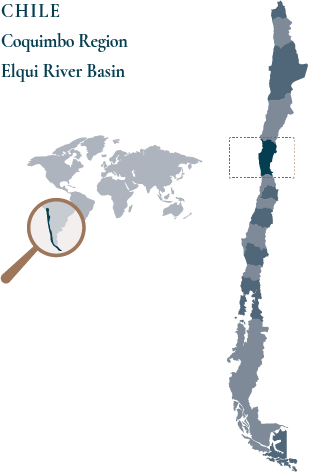
Undoubtedly, the Elqui Valley is a unique place. Located in the Province of Elqui, Coquimbo Region, it is an enchanting valley. It takes its name from the Elqui River, whose origins are at the confluence of its tributaries, the Claro and Turbio rivers, sourcing from the Andes Mountains. Considered one of the places with clearest skies in the planes the valley has many other remarkable features. A location of remarkable contrasts, with dry and rugged hills and small but fertile slopes, won with human ingenuity, where it seems that qualities were blended to create a unique condition, reflected on its pristine skies, crystal clear waters, sunny days, and cool and starry nights. This unparalleled scenery, together with the drive of the pioneers from the old continent, who brought with them their
ingenuity and their vines, and its descendants, resulted in generous and singular wines, from which alembic stills extracted their essence and turned it into Pisco. The hard work of generations in the valley has kept this spirit alive and transmitted it with pride and dedication.
The Swedish Academy, back in 1945, awarded our Chilean poet Gabriela Mistral, a native of Elqui, the Nobel Prize for Literature. She was always grateful and proud for her homeland, its people, and its fruits. She nostalgically remembered her roots when she wrote: "(...) I have a sense of smell taken from those vineyards and fig trees, and even my sense of touch came from those hills with sweet and rough pastures".

OUR VALLEY
Undoubtedly, the Elqui Valley is a unique place. Located in the Province of Elqui, Coquimbo Region, it is an enchanting valley. It takes its name from the Elqui River, whose origins are at the confluence of its tributaries, the Claro and Turbio rivers, sourcing from the Andes Mountains. Considered one of the places with clearest skies in the planes the valley has many other remarkable features. A location of remarkable contrasts, with dry and rugged hills and small but fertile slopes, won with human ingenuity, where it seems that qualities were blended to create a unique condition, reflected on its pristine skies, crystal clear waters, sunny days, and cool and starry nights. This unparalleled scenery, together with the drive of the pioneers from the old continent, who brought with them their
ingenuity and their vines, and its descendants, resulted in generous and singular wines, from which alembic stills extracted their essence and turned it into Pisco. The hard work of generations in the valley has kept this spirit alive and transmitted it with pride and dedication.
The Swedish Academy, back in 1945, awarded our Chilean poet Gabriela Mistral, a native of Elqui, the Nobel Prize for Literature. She was always grateful and proud for her homeland, its people, and its fruits. She nostalgically remembered her roots when she wrote: "(...) I have a sense of smell taken from those vineyards and fig trees, and even my sense of touch came from those hills with sweet and rough pastures".


WHAT DISTILLATES ARE
Distillation consists of heating a fermented solution (in the case of pisco, we are talking about wine) to separate the alcohol from the water and other elements. The process is carried out with a still, a recipient that contains the fermented product and is heated, so that the most volatile substances evaporate and then pass through a condenser, to return to the liquid state, and are reserved in another recipient in a concentrated and separate form.
Besides pisco, among the best-known distillates, we can mention cognac, brandy, rum, vodka, gin, whisky, and tequila. The differences among them are given, firstly, by the ferment that gives rise to them, and by the distillation technology used.
WHAT DISTILLATES ARE
Distillation consists of heating a fermented solution (in the case of pisco, we are talking about wine) to separate the alcohol from the water and other elements. The process is carried out with a still, a recipient that contains the fermented product and is heated, so that the most volatile substances evaporate and then pass through a condenser, to return to the liquid state, and are reserved in another recipient in a concentrated and separate form.
Besides pisco, among the best-known distillates, we can mention cognac, brandy, rum, vodka, gin, whisky, and tequila. The differences among them are given, firstly, by the ferment that gives rise to them, and by the distillation technology used.
INTERESTING DATA
-Since 2009, National Pisco Day is officially celebrated in our country on May 15th.
-Pisco is the most consumed distillate in Chile.
-In 2017 there was a big controversy, when it became known that Peru could not participate in the Concours Mondial de Bruxelles (which rewards the best liquors in the world, and that year was held in Chile) with its pisco since our legislation does not recognize it as such.
-"Pisco was born in Chile" is an essay based on information compiled by Argentine historian Pablo Lacoste and a group of collaborators. It presents a historical review of the national drink, from its beginnings -with the arrival of Spanish colonizers to these lands-, its development, until it became part of the culture and tradition of the northern valleys. This process resulted in the first Denomination of Origin in America. The essay was published by Ril Editores.
INTERESTING DATA

